
Self-Contained Fire Suppression Systems for Sites Without a Water Supply
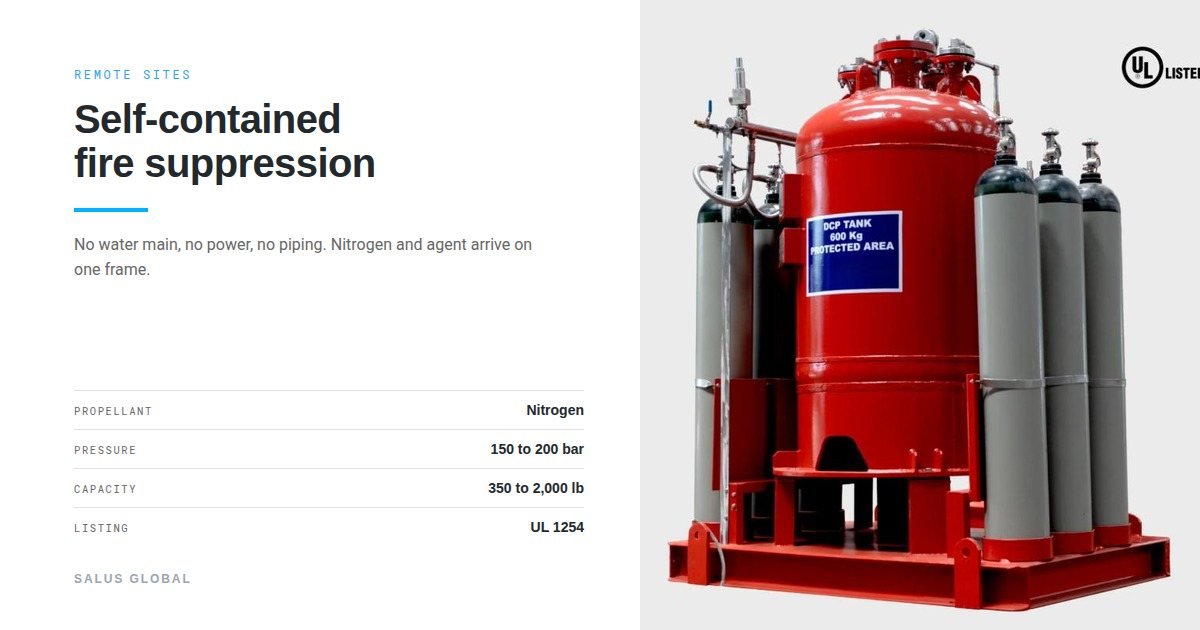

A self-contained fire suppression system carries its own agent and its own propellant, so it can discharge at full rate with no firewater main, no pump, no electrical supply and no fixed piping to the hazard. For open-air industrial hazards the practical options are nitrogen-propelled dry chemical skids, foam or twin agent skids with their own water tank, and trailer units that combine the two. The choice between them is decided by the fuel, the area, how far the hazard is from the nearest place a unit can stand, and whether anyone will be present to operate it. A 1,000 lb dry chemical skid with two nitrogen cylinders covers most loading rack, wellsite, compressor station and remote pump station hazards on its own; a larger pool fire needs foam, and foam needs water, which is the point at which a self-contained system starts carrying its own.
The term also attaches to much smaller equipment, worth separating out before anything is specified. A pre-engineered system on a haul truck, a condensed aerosol generator in a switch cabinet and a small clean agent unit in an analyzer house all carry their own agent and expellant, but each protects a machine or an enclosure, and each is actuated by detection rather than by a person. What follows is about the other kind, a unit that has to cover an open hazard at distance with nothing supplied to it.
What "no water supply" rules out
Most industrial fire protection assumes a firewater system: a ring main at 100 to 150 psi, a diesel pump house, hydrants, monitors and fixed deluge designed to NFPA 15. Take that away and the usable list shortens fast. Water spray and deluge are gone. Foam systems that proportion concentrate into a hydrant supply are gone, and with them the NFPA 11 fixed foam designs for tank and bund protection. Sprinklers were never relevant to an outdoor hazard. Gaseous agents under NFPA 12 and NFPA 2001 need an enclosure to hold concentration and are not an option in open air. What remains are agents that can be stored on the unit and expelled by stored gas, which in practice means dry chemical, foam solution carried in a tank, and the combination of the two.
Sites in this position are common and not exotic. Pipeline pump and compressor stations, tank batteries, frac pads, remote truck and rail loading points, jetties at the end of a long pier, mine haul fleets and airstrips all fall into it. Many have power, but a system that depends on power has a second failure mode, and power on a remote site is often the first thing isolated when a fire starts.
How a nitrogen-propelled dry chemical skid works without infrastructure
The skid is a pressure vessel holding dry chemical agent, fabricated and tested to ASME Section VIII, with one or more nitrogen cylinders charged to 150 to 200 bar mounted alongside. In storage the agent tank is at atmospheric pressure. On actuation the operator opens the nitrogen, the regulator brings it down to the working pressure of the tank, and the gas enters through a fluidizing manifold at the base that aerates the powder and carries it up the discharge tube, through the hose and out of the nozzle. Because the propellant is stored separately, there is no slow pressure loss through a seal over years in service, and because the gas enters from below the agent is fluidized on every discharge rather than compacted by it. That is why the skid, rather than the stored pressure extinguisher, is the format for a unit that may sit untouched for a decade and still have to discharge at full rate.
Salus Global builds these units in 350 lb, 1,000 lb and 2,000 lb capacities, UL listed to UL 1254 and designed to NFPA 17, as manual, stand-alone units with a hose reel and nozzle. Nothing on the skid needs a connection to the site. The agent is chosen for the hazard: Purple K (potassium bicarbonate) for hydrocarbon liquids, gases and LNG, where it delivers roughly twice the Class B effectiveness per pound of sodium bicarbonate; monoammonium phosphate where Class A material is present and residue on equipment is acceptable; sodium bicarbonate where cost matters more than performance. For combustible metals, which are Class D, none of these agents apply and a dedicated Class D powder is a different product.
Where dry chemical alone is enough, and where it is not
Dry chemical extinguishes by interrupting the flame chain reaction, with some smothering and radiant heat shielding as secondary effects. It is very fast on three-dimensional fires: a running fuel leak, a flange spray, a pressurized gas jet, a pump seal fire, an energized electrical cabinet. Knockdown on those hazards is measured in seconds, and no water-based agent matches it. What dry chemical does not do is cool. A fire knocked down on a hot manifold or a steel surface that has been burning for several minutes can reignite once the powder cloud clears, and the operator has to be ready to hit it again. Wind moves the cloud, so the operator works from upwind. The powder leaves residue, which on electrical switchgear and instruments is a cleanup cost rather than a safety issue, but is the reason monoammonium phosphate is avoided near sensitive equipment.
The limit is the pool fire. A large, deep pool of hydrocarbon in a bund keeps generating vapor from the hot liquid after the flame is interrupted, and without a foam blanket or cooling it relights. A skid will put out a spill fire of a few hundred square feet, but securing a bund fire on a storage tank is a foam job. On a site with no water supply that means a foam skid with its own water tank, or a twin agent unit where the dry chemical takes the fire out and the foam holds it out. The twin agent arrangement is the one most operators choose for remote liquid hazards because it covers both failure modes on one unit.
Sizing a self-contained unit when there is no backup
On a site with a firewater main the brigade can follow a skid discharge with hose lines. Without one, the agent on the skid is the whole response. Three figures settle the size. The first is the hazard area, taken as the largest credible spill or the equipment that can be involved in one event. The second is the flow rate, fixed by the nozzle and the listing rather than by the operator. The third is the discharge time. NFPA 17 sets a minimum of 30 seconds of flow through a hand hose line, which is a floor rather than a target. Industrial hand line nozzles commonly run between roughly 5 and 10 pounds of agent per second and throw the stream 25 to 40 feet, so a 1,000 lb unit discharging through one nozzle at the top of that range lasts a little over a minute and a half, and at the bottom of it a little over three minutes. With no backup coming, that margin is the whole reserve the operator has for a reignition or a second pass.
Capacity follows from flow rate multiplied by discharge time, with a margin for reignition. A loading rack with a credible 400 square foot spill, a hazard edge 80 feet from where the skid can stand, and a single operator is a typical 1,000 lb case. A compressor station with gas, lube oil and a larger footprint is where 2,000 lb or two units start to make sense, because two units at opposite corners cover a hazard that one unit cannot reach around. Hose length is part of the sizing and not an accessory: a unit placed so the operator has to walk through the hazard to reach the far side is mis-sized whatever its capacity. The arithmetic itself is short: nozzle flow rate multiplied by the discharge time, held against the NFPA 17 requirement that a hand hose line carry enough agent for at least 30 seconds of effective use, then a reserve on top for a second application if the first knockdown relights.
Trailers, mobile units and the case for moving the system to the fire
Where one site has several hazards spread over distance, or where the hazard itself moves, as on a frac pad or a construction site, a trailer unit can replace several fixed skids. The ZEUS Titan from Salus is a mobile firefighting trailer that brings agent and propellant to the hazard, so it can be towed to a wellsite, left for the duration of a completion and moved to the next one. The trade-off is response time. A skid stands at the hazard and is ready the moment someone reaches it; a trailer has to be positioned, and wherever it is parked it is not covering the other locations. For a production field with a dozen tank batteries the answer is often a trailer on the service truck plus fixed skids at the batteries with the highest inventory.
What the inspector and the insurer will ask
A self-contained unit is still a listed system and is still subject to NFPA 17. The AHJ will want to see the UL 1254 listing on the assembled unit rather than on a component, the ASME stamp on the tank and the nitrogen cylinder documentation. The insurer will want the monthly visual inspection log, the record of the semi-annual maintenance by trained personnel including the agent check for caking and moisture, and the 12 year hydrostatic test record for the cylinders. Remote sites tend to fail on the semi-annual, not on the hardware, because nobody is on site to do it, and a unit whose agent has caked through a failed seal will not discharge however much nitrogen is behind it. Separate nitrogen and an unpressurized tank make a unit forgiving of a missed inspection, not exempt from one.
Offshore and marine sites add corrosion to the list: 316 stainless steel tanks, marine coatings and sealed enclosures for the regulator and valve. Where the unit goes on a US-flagged vessel or platform under 46 CFR, confirm the model's US Coast Guard approval status before specifying it. For a land site on the Gulf Coast a carbon steel tank with a marine grade coating is normal practice. What matters on the day is that the gas reaches fluidized powder and the hose reaches the fire, and a self-contained skid is the simplest piece of fire protection on the site precisely because those are the only two things that have to work.
