
Fire Suppression Equipment Lead Times in 2026
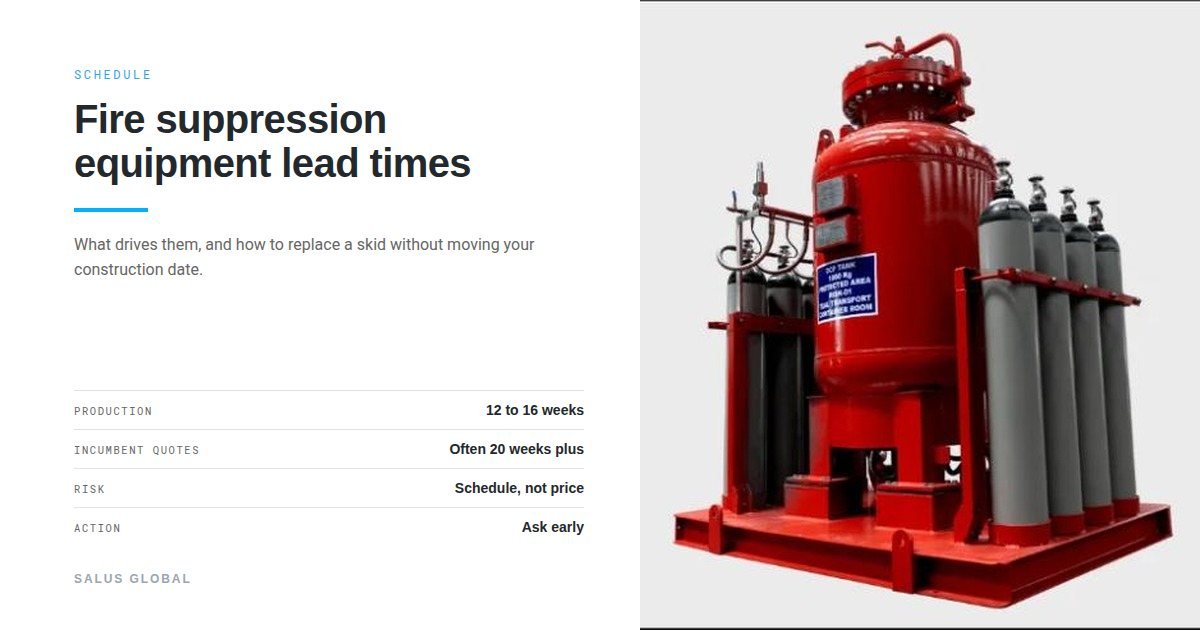

Fire suppression equipment lead times in 2026 can affect a project schedule if the order is placed only after the specification is approved. Dry chemical skids, fixed suppression systems and custom configurations can require significant procurement and fabrication time. The main schedule risks are pressure vessel fabrication, listed component availability, agent filling and testing, documentation, and the manufacturer's current production queue.
The practical ways to protect the schedule are to identify long-lead equipment early, freeze the required configuration, maintain a qualified alternate supplier, and complete the substitution review before a delay becomes critical.
Where Fire Suppression Equipment Lead Time Goes
A dry chemical skid combines a pressure vessel with firefighting hardware. The agent tank may be fabricated and tested to ASME Section VIII, while nitrogen cylinders, hose reels, regulators, valves and nozzles can have their own supply schedules.
For a UL listed system, the manufacturer also has to maintain the tested configuration. A component cannot simply be replaced with a different model because the original component is temporarily unavailable if that change affects the listing.
After the major components are available, the manufacturer still needs to complete assembly, agent filling, inspection, testing, painting and documentation. The actual fabrication time is therefore only one part of the overall lead time.
Production queues can also vary significantly between manufacturers. A supplier serving multiple industries may have a longer queue during refinery turnarounds or large industrial projects. For this reason, a lead-time statement from a previous quotation should not automatically be treated as the current delivery position.
Salus Global assembles, fills and inspects its dry chemical skids at its Texas facility. Current lead time should be confirmed against the required configuration, agent, coating, options and required-on-site date.
Why Fire Protection Equipment Becomes a Missed Project Milestone
Fire suppression equipment often appears late in the procurement schedule because it is not required until the protected equipment is approaching mechanical completion. However, the suppression system may need to be installed, inspected and accepted before fuel or other hazardous materials are introduced during commissioning.
For example, a skid with a 22-week lead time ordered at week 30 of a 52-week project would arrive around the end of the project schedule. If fuel introduction is planned for week 44, the project could face an eight-week gap between the required protection date and equipment delivery.
The better approach is to identify the required-on-site date during detailed design and place the order once the capacity, agent, hose configuration and layout are sufficiently frozen.
Replacing a Dry Chemical Skid on an Operating Site
Replacement planning is particularly important for operating facilities. A unit that fails an inspection because of caked agent may be serviceable after proper maintenance or recharge. A tank or cylinder that fails its required testing because of deterioration may require replacement.
A skid approaching a major inspection or hydrostatic testing interval can therefore be treated as a planned replacement candidate rather than waiting for a failure to create an impairment.
Facilities with multiple identical units may also consider maintaining a spare or rotating replacement unit. This can reduce the period during which a hazard is operating under temporary fire protection measures.
Keep a Qualified Alternate Supplier Ready
Depending on a single supplier creates a schedule risk if its production position changes. A qualified alternate can reduce that risk, provided the technical equivalence has already been reviewed.
The equivalence review should compare the proposed unit against the basis-of-design requirements, including:
- UL listing or other required approval
- Dry chemical agent
- Agent capacity
- Discharge rate
- Hose length and reach
- Nozzle configuration
- Materials and coating
- Pressure vessel requirements
- Nitrogen or other expellant arrangement
- Required drawings and documentation
Salus Global dry chemical skids are available in 350, 1,000 and 2,000 lb capacities and are UL listed to UL 1254. The agent tank is built and tested to ASME Section VIII, with separate nitrogen cylinders and a hose reel and nozzle forming part of the listed assembly.
The dry chemical powder skid data sheet, listing documentation and general arrangement drawings can be used as inputs during an equipment equivalence review.
Specifying or replacing a unit? Request a quote or request drawings for your hazard.
Five Ways to Reduce the Real Lead Time
The quoted manufacturing lead time is only part of the time between selecting equipment and having a working unit on site. The following steps can reduce avoidable delays:
- Freeze the layout early. Avoid revisions to the hose length, capacity or configuration after the order.
- Use a standard listed configuration. Standard equipment can avoid additional engineering and approval work.
- Confirm the agent early. Agent selection can affect availability, performance and the final configuration.
- Agree documentation requirements at order. This reduces the risk of equipment waiting for certificates or inspection records.
- Put the required-on-site date on the purchase order. Both the manufacturer and project team then have a clear delivery target.
The objective is not simply to find the shortest quoted lead time. It is to reduce the total time from specification freeze to an installed, inspected and accepted fire suppression system.
Frequently Asked Questions
Does a shorter lead time mean a lower-quality fire suppression system?
Not necessarily. Lead time depends on the manufacturer's production queue, component availability, configuration and supply chain. Compare the listing, agent, capacity, discharge data and documentation requirements rather than lead time alone.
Can commissioning start before the suppression skid arrives?
It may be possible under a documented temporary fire protection arrangement, but this depends on the AHJ, site requirements and insurer. Any temporary measure should be agreed in writing before commissioning begins.
When should a dry chemical skid be ordered?
The order should normally be placed once the capacity, agent, hose configuration and installation layout are sufficiently frozen to avoid major changes. The required-on-site date should be based on the commissioning and protection requirements rather than only on mechanical completion.
Can an existing dry chemical skid be replaced with another manufacturer's unit?
Potentially, provided the replacement meets the project's listing, specification, agent, capacity, discharge, reach, materials and documentation requirements. The proposed substitute should be reviewed and accepted by the responsible engineer, AHJ and insurer where applicable before procurement.
Check Current Salus Lead Times
Tell us your required-on-site date and dry chemical skid configuration, and Salus Global can confirm the current delivery position.
