
How to Size a Dry Chemical Skid: Agent Quantity, Hose Reach and Discharge Time
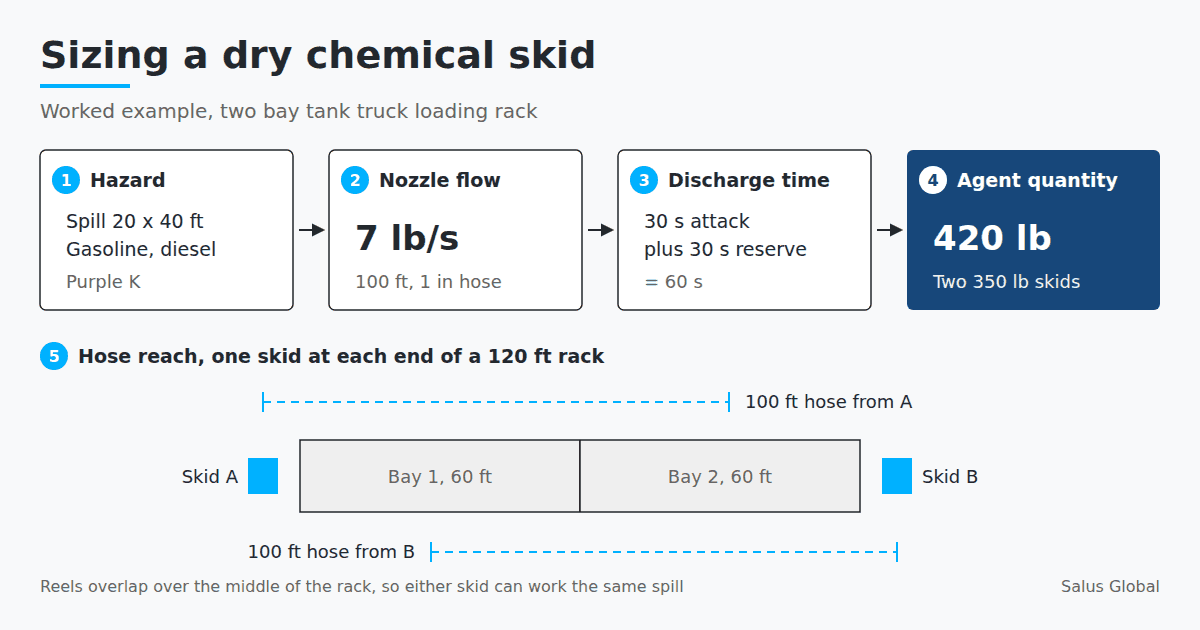

A dry chemical skid is sized from three numbers: the flow rate of the nozzle in pounds per second, how long you want that flow to last, and the distance from where the skid can stand to the far edge of the hazard. Multiply rate by time and you have the minimum agent quantity; lay the hose length over the plot plan and you have the reach. Everything else, from agent choice to nitrogen cylinder count, follows.
Start with the nozzle, not the tank
Buyers tend to start with tank capacity because that is how skids are cataloged, 350, 1,000 and 2,000 lb in the Salus Global range. The better starting point is the nozzle, because on a unit listed to UL 1254 the nozzle and hose are part of the listing and the rate is set by the orifice and the regulated nitrogen pressure behind it.
Published figures for hand line nozzles sit in a band of roughly 5 to 10 lb/s. Flow rate is locked to capacity by the duration the unit has to sustain. NFPA 17 requires a hand hose line to hold enough agent for at least 30 seconds of use. For example, 350 lb at 10 lb/s is gone in 35 seconds, while the same 350 lb at 7 lb/s runs 50 seconds. Use the actual flow rate from the equipment data sheet for final sizing.
Decide the discharge time from the hazard, then add margin
Discharge time is the part that takes judgment. Dry chemical interrupts the flame chain reaction, and where the agent reaches the base of the flames it can achieve rapid knockdown. Operators still need time to approach, sweep the nozzle, manage wind and retain enough agent for a flare-up while the fuel is being isolated.
The 30 second floor is a minimum, not necessarily the complete design basis. A practical planning approach for a manually operated skid on an outdoor Class B hazard is to provide enough agent for the operator to make a full attack on the design fire and retain reserve for a second attack or for isolation delays.
For example, 60 seconds at 7 lb/s requires 420 lb of agent. A 350 lb skid would therefore be below that planning basis, while a 1,000 lb unit provides substantial additional capacity. Fuel supply matters as well: a leak fed by a pump or pressurized line can continue burning until the isolation valve closes, so the reserve should reflect the isolation time.
Sizing a unit for a real hazard? Send us the dimensions and we will check the sizing basis with you.
Hose reach is a plot plan exercise
Agent quantity is only useful if the nozzle can reach the fire. Manufacturers publish stream ranges for hand line nozzles, but these figures depend on the specific nozzle and operating conditions. Crosswind can reduce effective reach significantly.
Mark the skid on the plot plan, draw the hose length from that position, allow for the hose bending around obstructions, and check that the hazard falls inside the practical operating range. Do not rely on straight-line distance alone. Reels commonly carry 50 to 150 ft, with the final configuration determined by the listed equipment.
Two smaller skids at opposite ends of a linear hazard can sometimes provide better coverage than one large unit in the middle. A jetty or long loading rack may require the same approach because the skid cannot necessarily be positioned directly beside the hazard.
Worked example: a two-bay tank truck loading rack
Take a loading rack with two bays under one canopy, 120 ft end to end, loading gasoline and diesel. The design fire is a spill under one truck during loading, roughly 20 ft by 40 ft before it drains to the catch basin. Emergency shutdown is a pushbutton at one end of the rack, and the pumps stop within 10 seconds. There is a trained operator on every shift and no fire water main at the rack.
Step one, agent. Gasoline and diesel are hydrocarbons, so potassium bicarbonate, Purple K, is the selected agent in this example. Step two, flow rate. The equipment data sheet provides 7 lb/s through 100 ft of 1 inch hose. Step three, discharge time. Allow 60 seconds as the planning basis, including reserve for the operating conditions described. Step four, agent quantity. Sixty seconds at 7 lb/s is 420 lb.
Step five, reach. From the shutdown end, the far corner of the rack is 120 ft away while the reel holds 100 ft. Neither the quantity nor the reach is adequately addressed by a single 350 lb unit at that position. Two 350 lb skids, one at each end, provide 700 lb of combined agent capacity and reduce the hose run required to reach the hazard. A single 1,000 lb unit may provide more agent but does not automatically solve a hose-reach problem.
Nitrogen, fluidization and what the tank size does not tell you
Capacity on the nameplate is agent weight, and the propellant is sized to match. Salus skids carry charged nitrogen cylinders separate from the agent tank, with the regulator reducing the gas to the tank's working pressure during actuation.
Cylinder count is determined by the manufacturer for the listed capacity and discharge configuration. The fluidization design, which introduces gas to lift and entrain the powder, helps maintain a consistent discharge rate and effective agent delivery.
The tank size also says nothing about the agent's condition. A charge that has caked through moisture ingress may not flow correctly. This is why NFPA 17 maintenance includes examination of the agent and why storage conditions and inspection history matter when specifying a unit that may remain unused for extended periods.
Frequently asked questions
Can a skid be oversized to be safe?
Within the limits of the listed configuration and the project requirements, a larger unit can provide additional agent reserve. The trade-offs include cost, footprint and fully charged weight. Oversizing does not automatically solve a reach problem; additional or differently positioned units may be required.
Does the flow rate change with the agent?
It can. Different dry chemical agents have different flow characteristics, so the final flow rate should come from the equipment data sheet for the exact agent and hardware combination. The listing covers the applicable agent and equipment configuration together.
What does the sizing worksheet cover?
The key inputs are the hazard dimensions, fuel, required agent, nozzle flow rate, desired discharge time, isolation time, skid location and hose reach. These inputs allow the required capacity and configuration to be checked against the applicable equipment listing and project requirements.
Size it with an engineer
Give us the hazard area, the fuel and the access, and we will come back with a capacity, a flow rate and a drawing.
