
What Is the Dry Chemical in a Fire Extinguisher?
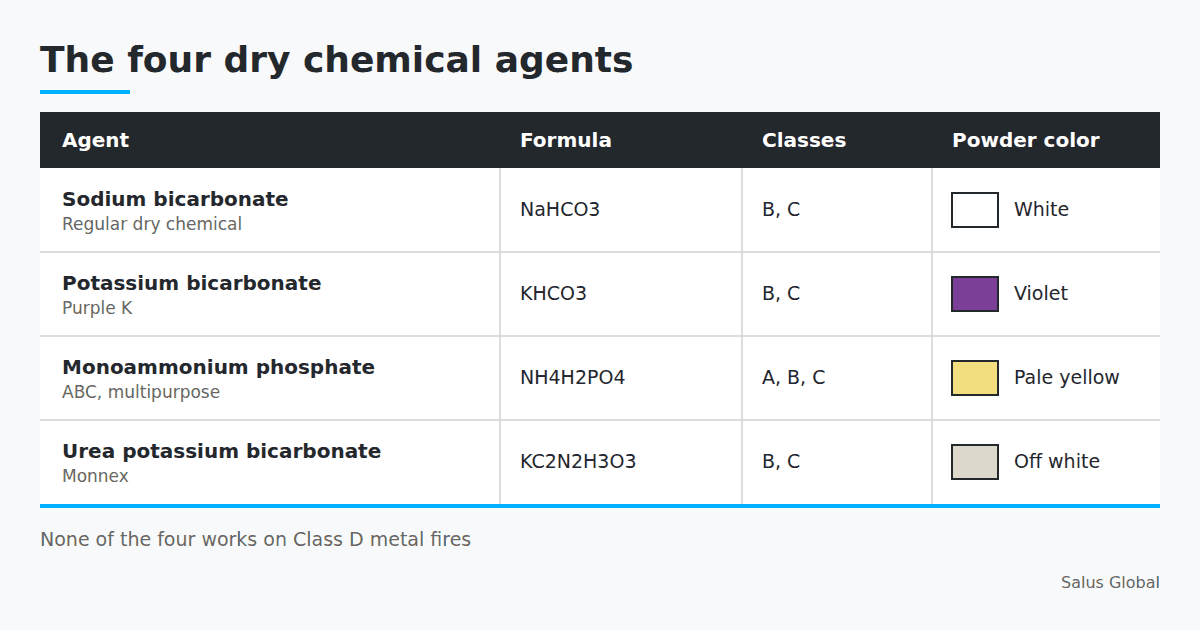

The dry chemical in a fire extinguisher is one of a small family of finely ground salts. The most common is monoammonium phosphate, the pale yellow ABC powder in the extinguisher on an office wall. Sodium bicarbonate, the white BC powder, is ordinary baking soda milled fine and treated to flow. Potassium bicarbonate, dyed violet and sold as Purple K, is the agent in most extinguishers on refineries, airports and fuel terminals because it puts out roughly twice as much flammable liquid fire per pound as sodium bicarbonate. A fourth, urea potassium bicarbonate (Monnex), is the highest performer and the most expensive.
The Four Dry Chemical Agents
| Agent | Chemical | Fire Classes | Color | Common Uses |
|---|---|---|---|---|
| Sodium bicarbonate | NaHCO3 | B, C | White | General Class B extinguishers, low-cost industrial systems |
| Potassium bicarbonate (Purple K) | KHCO3 | B, C | Violet | Petrochemical, LNG, aviation, marine and industrial hazards |
| Monoammonium phosphate (ABC) | NH4H2PO4 | A, B, C | Pale yellow | Offices, warehouses, vehicles and mixed hazards |
| Urea potassium bicarbonate (Monnex) | KC2N2H3O3 | B, C | Off-white to gray | High-value Class B hazards where performance per pound matters |
Monnex is not a simple blend of urea and potassium bicarbonate but the reaction product of the two, a potassium allophanate, which is why it behaves differently in the flame. Potassium chloride, commonly called Super K, is another BC agent with performance similar to Purple K but a more corrosive residue, so it is less commonly specified.
The color of the powder can also help identify the agent during inspection and recharge. Different dry chemical agents are formulated for different fire classes, and they should not be mixed during servicing.
How Dry Chemical Puts Out a Fire
Dry chemical agents primarily work by interfering with the chemical chain reaction that sustains a flame. When bicarbonate or phosphate particles enter the flame, the active chemical species interact with the free radicals involved in combustion and interrupt the reaction. The result is rapid flame knockdown.
This explains why potassium bicarbonate generally outperforms sodium bicarbonate on Class B fires. Potassium is more effective at interfering with the flame chemistry, allowing Purple K to deliver high extinguishing performance with a relatively small quantity of agent.
Monoammonium phosphate also has an additional effect on Class A fires. As it decomposes in the heat, it forms a coating over burning solid materials, helping isolate the fuel from air. This makes ABC powder suitable for ordinary combustibles such as wood and paper as well as Class B and C hazards.
Why Dry Chemical Must Be Kept Dry
Dry chemical powder needs to remain free-flowing to discharge correctly. Moisture can cause the powder to cake, reducing its ability to move through the extinguisher, hose or piping.
Extinguisher-grade agents are therefore processed and treated to improve flow and resistance to moisture. Proper sealing and inspection are also important. If moisture enters a cylinder or agent vessel, powder can cake around the discharge path and prevent the system from delivering its rated flow.
This is particularly important for larger industrial systems. A dry chemical skid uses a sealed agent vessel and a fluidization arrangement to help keep the powder suspended during discharge. Salus Global dry chemical skids use separate nitrogen cylinders to pressurize and discharge the agent.
Dry Chemical vs. Dry Powder
Dry chemical and dry powder are not interchangeable terms in fire protection.
Dry chemical generally refers to agents used for Class B and Class C fires, including sodium bicarbonate and potassium bicarbonate. Dry powder refers to specialized agents designed for Class D combustible-metal fires.
Magnesium, titanium, sodium and lithium fires require dedicated Class D agents. These may include powders based on sodium chloride, copper or graphite. Using a standard bicarbonate dry chemical agent on a combustible-metal fire is not an appropriate substitute for a listed Class D extinguishing agent.
Where Industrial Dry Chemical Is Used
Potassium bicarbonate and other dry chemical agents are widely used where rapid knockdown of flammable liquid or gas fires is required. Typical industrial applications include refinery pump areas, loading racks, fuel terminals, LNG facilities, aviation facilities, marine installations and other process areas with Class B hazards.
For larger hazards, the same principle can be applied through a dry chemical powder skid. These systems provide significantly more agent than a portable extinguisher and can be equipped with hose reels for manual firefighting.
Where a fixed installation is required, dry chemical can also be delivered through an engineered dry chemical powder system with piping and fixed discharge nozzles.
Frequently Asked Questions
What is the most common dry chemical in a fire extinguisher?
Monoammonium phosphate is commonly used in ABC extinguishers, while sodium bicarbonate and potassium bicarbonate are common BC dry chemical agents. The appropriate agent depends on the fire classes and hazard being protected.
What is Purple K dry chemical?
Purple K is potassium bicarbonate, a BC dry chemical agent known for high performance against Class B flammable-liquid fires. It is commonly used in industrial, petrochemical, aviation and fuel-handling applications.
Is dry chemical powder toxic?
Dry chemical discharge can create a dense airborne powder cloud that irritates the eyes and respiratory system and significantly reduces visibility. Personnel should follow the site's fire response procedures and applicable safety requirements when operating or servicing dry chemical equipment.
Can dry chemical be used on electrical fires?
BC and ABC dry chemical extinguishers are rated for Class C energized electrical equipment when used according to their listing. However, the residue left by some agents can damage sensitive electrical and electronic equipment, so the hazard and cleanup requirements should be considered when selecting the suppression method.
Need Dry Chemical Protection for an Industrial Hazard?
Salus Global supplies dry chemical skids and fixed systems for Class B and C industrial fire hazards.
